Categories
Advice

Does my boiler need replacing?

Thinking about a boiler replacement?

What do you rely upon more than anything else in your home? Probably your boiler.

Although we don’t often think of them until trouble strikes, boilers are the unsung heroes of our warmth and comfort at home.

They provide us with heat and hot water all year round, and they’re often so good at their job, we take them for granted.

But unfortunately, boilers don’t last forever.

If you’ve noticed your boiler is struggling to do what it used to do; or is breaking down regularly; or is not working at all, you might be wondering whether you should try to repair what you have, or whether the time has come for a boiler replacement.

If so, you might like our related blog: 6 signs that you need a new boiler.

The Heating People are here to help you find what’s right for you, and your home. Call us today to discuss your options with a boiler replacement.

Signs that you might need a boiler replacement

Here are some of the signs that it might be time to replace your old boiler with a new one:

Sign it’s time for a boiler replacement: Your boiler is in its ‘golden years’

When you’re thinking about replacing your boiler, it’s a good idea to start by considering it’s age.

A new boiler is unlikely to need to be replaced, but what’s considered an ‘old’ boiler?

There isn’t an easy answer to this question, because just like with us, age really is just a number!

There’s a common misconception that when a boiler reaches a certain age, it needs to be replaced. But this isn’t true.

With regular servicing, some reliable old boilers will keep ticking over, without ever giving much of a grumble.

However, others will start to deteriorate, and may start breaking down, and needing more frequent repairs.

So if your boiler is old, and you notice any of the other warning signs listed below, call The Heating People today.

We’ll advise you on whether it’s time to say goodbye to the old, and hello to the new.

Sign it’s time it’s time for a boiler replacement: Your energy bills have crept up without explanation

You might have heard about the energy efficiency ratings of boilers, or of the Boiler Plus regulations ; but you might not understand what it can mean for your household energy bills.

In its simplest terms, a less efficient boiler costs more to run because they use more energy to heat your home.

An A rated boiler has an energy efficiency of 90% or more.

The Boiler Plus regulations mean that new combi boilers are at least 92% efficient.

To put this in perspective, an older G rated boiler has an efficiency of 70% or less which means for every £1 you spend on your heating bill you are wasting 30p on lost energy.

As well as older boilers tending to be less efficient to start with, their efficiency can also deteriorate further with age.

So if you have an old boiler, and ever increasing energy bills, it might be worth discussing whether a new boiler could save you money.

You might also like to read our related blogs: 22 tips to reduce your gas bill and 10 tips for saving money on your energy bills.

Sign it’s time for a boiler replacement: Replacement parts are hard to find because of the age of your boiler

If your boiler is very old, it might be pricey to repair if it breaks down, because manufacturers often discontinue spares and accessories on older models.

If it’s difficult for your engineer to find the parts, or expensive to replace them, you’ll need to consider how often you’ll have to do this.

A one-off repair might be ok, but if you’re finding that your engineer is regularly having to scour the internet for obsolete parts, it might be more economical to get a new boiler.

Sign it’s time for a boiler replacement: Your heating system isn’t working like it used to

Over time, you might have noticed that your heating system isn’t working like it used to.

If your radiators are taking ages to get hot, or you’re always cold in certain rooms, or you can’t seem to get enough hot water, it’s time to call an engineer to investigate whether it’s time to replace your boiler.

Sign it’s time for a boiler replacement: Your boiler is regularly breaking down

If you’re having to call out an engineer more than once a year to repair your boiler, it’s worth considering whether the sum of repairs and call-outs is greater than the cost of a new boiler.

If you have your boiler serviced regularly, it should be running smoothly all year, so it might be time for a replacement if yours is still struggling.

Sign it’s time for a boiler replacement: Your boiler or radiators are noisy

All heating systems will make some noise, but if you start noticing new or unusual sounds coming from your heating system, you should get it checked.

If you have tapping sounds, your system might benefit from a Powerflush to clear out sludge which builds up over time.

Other sounds, such as humming or banging might indicate a bigger fault. Your engineer will be able to talk to you about whether repairs or replacements are needed in your situation.

Sign it’s time for a boiler replacement: The flame in your boiler has changed from a blue to a yellow colour

The flame in your boiler should be bright blue. If it changes colour, you should contact a Gas Safe engineer immediately.

The Heating People will be able to advise you as to whether a repair is possible, or whether you need to replace.

Sign it’s time for a boiler replacement: Your boiler smells odd when it is on

A hazard sign.If you ever smell sulphur or an eggy odour when you use your boiler, there could be a gas leak.

Immediately turn off the boiler and call the emergency gas line on 0800 111 999.

Then get in touch with a Gas Safe engineer. You should do this if you ever notice an unusual smell coming from your boiler.

Sign it’s time for a boiler replacement: Your boiler is leaking waterYour boiler should never leak! If it does, you need to switch it off and have it checked by a professional.

It could be a broken valve or seal, which might be repairable, or it could be indicative of a bigger problem, where a replacement might be your better option.

Sign it’s time for a boiler replacement: Your boiler is not working at all

If your boiler stops working completely, it doesn’t necessarily mean that you need a brand new one, but it’s definitely worth talking to your engineer about whether repair or replacement is the best option for you.

What will I stand to gain from a boiler replacement?

If you recognise any of the warning signs that your boiler might be on its last legs, you might be wondering what you stand to gain from a replacement.

Here are just some of the advantages to investing in a new boiler:

Benefit of replacing your boiler: A warmer, more comfortable home

If you’ve been feeling chilly lately because your old boiler has been struggling to heat your home, you’ll love the benefits that a modern boiler will bring.

No more waiting for a heating system that takes ages to kick-in, or wearing two jumpers in your lounge!

Benefit of replacing your boiler: More reliable hot water

If baths and showers have been a battle ground lately, because there never seems to be enough hot water, a new boiler might solve this for you.

If your current problem is that you’re having to wait ages for water to heat up, a combi boiler might fix this for you.

Or, if your issue is that your combi isn’t coping with the increased demands of a growing family, switching to a heat-only or system boiler might be your answer.

Whatever the situation, our team at The Heating People can make sure that your upgrade is going to meet your hot water needs.

Benefit of replacing your boiler: Quieter boiler operation

Fed up of your banging or whistling boiler?

If your old boiler was really noisy, you might well notice how much you don’t notice your new one!

Due to improved design, new boilers can be significantly quieter than older ones.

Benefit of replacing your boiler: Space saving

If you currently have a heat-only boiler, and switch to a system boiler, you’ll save space because system boilers only have a hot water cylinder, they don’t need a cold water tank in the loft.

And if you switch to a combi boiler, you’ll save even more space because combis are compact all-in-one units that don’t need any external tanks or cylinders. They often fit in a kitchen cupboard.

So replacing your boiler could mean that you can get your airing cupboard back, which can be particularly beneficial in smaller homes.

Benefit of replacing your boiler: Reduced energy bills

A family putting coins into a piggy bankA major advantage of a boiler replacement, is that it could save you a lot of money on your energy bills.

The Energy Saving Trust estimates that boilers are responsible for 55% of your household energy bills, so upgrading from a G rated to an A rated boiler could save you up to £200 per year!

To find out why the price of gas is on the rise, check out our related blog here.

So it’s definitely worth having an efficient boiler in your home!

Benefit of replacing your boiler: Better for the environment

There’s no doubt that by installing a new, more efficient boiler, you are also helping the environment.

It’s estimated that around 20% of all UK carbon emissions come from home heating.

Modern A-rated boilers are superior to their older, lower rated counterparts because they recycle heat that would be wasted. This means that they can generate more heat from the same amount of fuel.

It’s estimated that by moving to an A-rated boiler, you could save the environment 1,500kg of carbon dioxide per year.

Benefit of replacing your boiler: More control
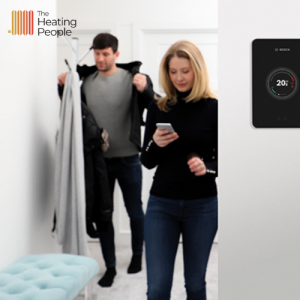
A woman operating smart heating from her phone.When you replace your boiler, it’s the perfect time to upgrade your heating controls too.

Effective heating controls are a vital part of an efficient central-heating system.

If you’re replacing an old boiler with a much newer one, chances are, your new model will allow you to have much more control over the heat in your home, than in the past.

Clever use of controls can help you minimise energy consumption by ensuring each room is at the right temperature for comfort.

Smart controls allow you to remotely control your heating system, wherever you are in the world.

Benefit of replacing your boiler: Peace of mind

If your old boiler has been keeping you up at night with worry, all of that will end with a new reliable boiler.

You’ll end all the stress about strange noises and constant breakdowns.

No more inconvenience in having to arrange last-minute call-outs and repairs.

A new boiler should work better for longer, and all new boilers with The Heating People come with guarantees of up to 14 years, for your peace of mind.

Benefit of replacing your boiler: Manufacturer’s guarantee

All of the boilers supplied by The Heating people come with a guarantee of up to 14 years.

This means that should your boiler breakdown, all labour and materials required to get the boiler back to working order are covered.

Now how’s that for peace of mind?

Benefit of replacing your boiler: Reduced repair costs

The guarantee on your new model will mean that should anything go wrong, repairs will be paid for. Anything outside of guarantee is likely to cost less than repairs on a very old boiler, where manufacturers have discontinued parts.

Benefit of replacing your boiler: More convenient location

Renovating your home? If so, the location of your current boiler might not be convenient, and a replacement boiler might be in order to get your boiler where you need it to be.

Benefit of replacing your boiler: Make your home more attractive to buyers

Thinking of moving home soon? A new A-rated boiler can make your property more attractive to prospective buyers.

How much will a boiler replacement cost?

The cost of a new boiler depends on the type of boiler you wish to install and the system that you already have. However, the cost is generally around £1800 with The Heating People. 

How long will a boiler replacement take?

The time taken to complete a boiler replacement will vary depending upon what system is already in place (and it’s condition) and what it is being replaced with. Installations typically take between 1-3 days.

Which boiler brands do The Heating People work with?

Liam next to an ATAG boiler installation.The Heating People can work with any boiler manufacturer on the market, because we’re not tied to one manufacturer. This means that we can give you the best advice for you.

However we are proud to be Accredited Installers of:

  • Vaillant
  • Worcester Bosch
  • ATAG
  • Viessmann

You might like our related blog: 6 top tips for buying a new boiler.

Contact one of our friendly team at The Heating People to arrange to talk to an expert about whether a replacement is a good plan for you, and what your options are.

Useful Links:

https://assets.publishing.service.gov.uk/government/uploads/system/uploads/attachment_data/file/718569/Boiler_Plus_Factsheet_v3.pdf

Categories
Advice

Why choosing a Gas Safe engineer is so important

We all know that gas can be dangerous. So its vital that you choose a Gas Safe engineer to ensure your gas work is carried out legally and safely.

Rest assured that engineers at The Heating People are Gas Safe registered for working on gas.

Your safety is of paramount importance to us. So, in today’s blog we want to explain why choosing a qualified engineer is vital.

Not just to keep you and your family safe, but to keep your boiler running smoothly too.

What are the risks of having unsafe gas appliances at home?

If you have any gas appliances in your home; so it’s essential to have them checked once a year by a Gas Safe engineer to keep them safe.

If any of your appliances are improperly fitted; repaired; or maintained; or any of their vents; flues; or chimneys have become blocked, they can pose three main risks to life:

  1. Gas leaks

A gas leak can cause fires or explosions. So, if you think you can smell gas, then you’ll need to call your emergency service provider immediately.

During a gas safety check; a Gas Safe registered engineer will do a visual inspection of pipework; and a tightness test to confirm there aren’t any gas leaks.

  1. Fires and explosions

Safe appliances burn gas in a controlled way. But faulty appliances or pipework can potentially leak gas. If ignited, this causese fires and explosions.

  1. Carbon monoxide poisoning

If any of your gas appliances aren’t burning their fuel as they should; they can produce a highly poisonous gas called carbon monoxide (CO).

Exposure to this gas can lead to death; and it’s especially dangerous because you can’t see, taste or smell it.

Thankfully you can avoid all of these dangers, by making sure that you have a gas safety check once a year by a Gas Safe registered engineer. 

What is Gas Safe?

The Gas Safe Register is the official list of gas businesses, who can work safely and legally on boilers; cookers; fires; and all other gas appliances.

It’s the only official gas registration body of the United Kingdom, the Isle of Man and Guernsey.

It’s a legal requirement that gas engineers are listed on the Gas Safe Register.

The Gas Safe Register issues licenses for engineers to undertake gas work on behalf of a registered business. They must evidence competency through valid and current qualifications.

Is Gas Safe different to CORGI?

‘CORGI’ no longer exists. Because it was replaced by The Gas Safe Register on the 1st of April 2010. So, The Gas Safe Register is the only gas registration body in Great Britain and the Isle of Man.

What does the law say about Gas Safe?

Only Gas Safe registered engineers can legally fit, fix, and service gas appliances. This requirement ensures that engineers who are working on gas hold valid and current qualifications.

Rest assured, our engineers are Gas Safe registered.

What does the Gas Safe Register do?

The Health and Safety Authority for each region operates the Gas Safe Register.

The Gas Safe Register can’t recommend a particular Gas Safe registered engineer over another. So what exactly is their role?

Here’s a handy guide to what the Gas Safe Register does, and doesn’t do:

What the Gas Safe Register does:

  • Operates the official UK list of gas businesses and qualified gas engineers; so that only qualified engineers are licensed to legally work on gas.
  • Inspects businesses on the Gas Safe Register so that they are applying gas competence.
  • Investigates gas safety complaints.
  • Applies sanctions for unsafe work or breaches of rules of registration.
  • Investigates reports of illegal gas work and reports their findings to the Health and Safety Executive (HSE).
  • Undertakes consumer campaigns to raise the awareness of gas safety issues such as carbon monoxide (CO); and the dangers of using illegal engineers not on the Gas Safe Register.
  • Provides a facility for registered businesses to notify that the installations of heat producing gas appliances; and the hot water and heating systems they serve; are compliant with the Building Regulations in England and in Wales.

The Gas Safe Register do not:

  • Have the authority or ability to recommend a registered engineer. 
  • Employ the Gas Safe registered businesses or engineers.
  • Investigates or deal with matters such as: financial, contractual or commercial disputes.

So in other words, you can check whether your engineer is Gas Safe via the Gas Safe register.

This gives you the peace of mind that they will be operating legally and safely.

Why is it important to use a Gas Safe engineer?

Choosing a Gas Safe engineer to work on your gas appliances is a legal requirement. It’s vital for your safety in avoiding risk of fire, explosion and carbon monoxide poisoning.

Regardless of what type of gas appliance your engineer is fixing; be it a boiler; oven or gas fire; it’s crucial that your engineer is technically competent and follows all of the relevant health and safety regulations.

Gas Safe engineers demonstrate competence through their qualifications and are therefore licensed to undertake gas work.

In addition to their qualifications, they receive ongoing support to ensure their work meets current regulations; and is technically of a high standard.

Gas Safe engineers perform gas work safely, and prevent harm from occurring.

Gas Safe engineers assess the physical condition of your gas appliances, installation pipework, air vents and any flues for deterioration.

They carry out performance tests to ensure your appliances are operating safely and efficiently. They take any necessary remedial action, alerting you to any issues.

How to check whether an engineer is Gas Safe registered

Not all engineers are qualified to do all types of gas work. So you should check whether they’re Gas Safe registered, before you employ them.

You can inspect an engineer’s official ID card before any work is carried out.

The ID contains important information about the engineer. It says who they are; states their licence number; the business they work for; and the work they are qualified to carry out.

You can check the back of the ID card to see the qualifications that your engineer holds.

They divide qualifications into domestic and non-domestic categories. And list the name of the work they are qualified to undertake along with the expiry date.

You should check that your engineer has the relevant qualification to carry out the work required. For example, if they have come to service your boiler it should list ‘Gas Boiler’.

Also check that the qualification has not expired. 

How to check with the Gas Safe Register

You can check if a business is currently Gas Safe registered by entering their business registration number; or their trading name at: https://www.gassaferegister.co.uk/find-an-engineer/.

If you don’t know their registration number; or business name; or it is not returned as a search result; you can send an email to the Gas Safe Register at register@gassaferegister.co.uk. They will be able to confirm the businesses registration status for you.

Unfortunately, the Gas Safe Register cant recommend a Gas Safe engineer over another one. But they can tell you whether a business is registered to work on gas, or not.

What happens during a gas safety check?

Only Gas Safe engineers can carry out gas safety checks. A Gas Safe engineer will test your gas appliances to make sure they’re safe.

At The Heating People, our engineers will check that your appliances are:

  • Properly set and adjusted so the gas burns correctly;
  • Are suitable for the room it’s located in;
  • Is physically stable, securely fitted and properly connected to the gas pipework.

We will also check that:

  • There’s an adequate and permanent air supply that’s suitable for the appliance installed;
  • All safety devices are functioning properly;
  • Any flues, chimneys and air vents are operating correctly.

We can extend to a full gas installation safety check, in which we will:

  • Check the installation is in good condition by visually inspecting the pipework as far as reasonably practicable;
  • Test the gas pipework to make sure there are no leaks.

Do Gas Safe engineers provide any particular documentation following completion of gas work?

When an engineer undertakes gas work at your property; it’s helpful to know what documentation you can expect to receive from them.

The documentation an engineer leaves after having fitted; serviced; or safety checked an appliance; depends upon the purpose and type of work involved.

Building Regulations Compliance Certificate

If a Gas Safe registered engineer installs a heat producing gas appliance in your property; you will receive a Building Regulations Compliance Certificate.

This informs the Local Authority of the new appliance. And you should receive it in the post within 28 days of a new appliance being installed.

Landlord Gas Safety Record

The law requires all gas engineers to be on the Gas Safe Register. But they don’t have to provide a Gas Safety Record after they visit you, unless you’re a landlord.

The only documentation required by law is a Landlord Gas Safety Record.

This is because landlords have a legal duty to ensure residential properties are safe for their tenants.

Landlords must employ a Gas Safe engineer to perform an annual gas safety check on all gas appliances. The Landlord Gas Safety Record records the results.

Landlords should give a copy of this record to their tenants; so that they know that their appliances meet the appropriate safety standards.

What steps should I take for Gas Safety?

To sum up, here are the key steps that you can take to ensure that your home stays safe:

  • Find a Gas Safe registered engineer that you can trust

Remember that only Gas Safe registered engineers can legally fit, fix, and service gas appliances.

You can find a Gas Safe registered engineer at GasSafeRegister.co.uk (the UK’s official gas safety body) by postcode; by company name; by service and areas of work.

Our engineers are Gas Safe registered; and will be happy to show you their ID cards.

  • Get your engineer to service your boiler (and gas appliances) every year

Remember that you must have all of your gas appliances checked each year to check they are burning gas properly.

Npower says 61% of the UK hasn’t had their boiler serviced in the last year. This is very worrying! It’s vital we take precautions in our home to protect ourselves and our families from the dangers of gas. 

  • If you are a tenant – ask your landlord for a copy of the gas safety record

You’re entitled to a certificate that guarantees the gas fitting has been checked; and meets the national safety standards. Landlords are legally responsible for providing you with a gas safety record.

  • Be aware of the warning signs of unsafe gas appliances

Warning signs include higher levels of condensation in your home; black marks on your gas appliances; yellow or orange flames of the gas cooker (rather than blue).

  • Be aware of the 6 signs of carbon monoxide poisoning

The six warning signs of CO poisoning are:

  1. Headaches;
  2. Dizziness;
  3. Breathlessness;
  4. Nausea;
  5. Collapse;
  6. and loss of consciousness.

You can fit a carbon monoxide alarm, which alerts you to any carbon monoxide leak around your property.


Final thoughts…

We hope that you’ve found this blog helpful in understanding why choosing a Gas Safe Registered engineer is sso important.

An annual boiler service gives you the peace of mind that you and your family are safe.

Useful Links:

https://www.gassaferegister.co.uk/

https://www.hse.gov.uk/gas/gas-safe-register-check.htm

https://www.hse.gov.uk/gas/domestic/newschemecontract.htm

https://www.npower.com/help-and-support/emergency-information/gas-safety-advice/

https://www.nhs.uk/conditions/carbon-monoxide-poisoning/

https://www.gassaferegister.co.uk/help-and-advice/carbon-monoxide-poisoning/

https://www.gassaferegister.co.uk/gassafetyweek/

Categories
Advice

7 Central Heating Myths debunked

There’s nothing like a bit of snow and frost to get people falling into the trap of cranking up their thermostats in an effort to keep warm.

If you’ve done this yourself, don’t worry, you’re not alone. According to a survey by the Energy Saving Trust, 52% of people are guilty of doing this!

Lots of people mistakenly believe that by turning up their thermostat, their homes will get hotter quicker – but this is a central heating myth.

When it comes to heating our homes, there are a surprising number of myths out there.

So today, we’re looking at some of the most common misconceptions, to help you separate heating fact from fiction.

Central heating myth 1 – Turning up your thermostat heats a room quicker

We understand that when it’s freezing outside, it’s tempting to turn up your thermostat.

But this won’t heat your home any quicker, it just wastes energy and money.

This is because thermostats don’t have any control over the speed at which your house heats up. Thermostats just set the maximum temperature that you want your room to be.

So, if you’ve let your home get freezing cold, there’s no point cranking your thermostat up to 28 degrees. Your home will still heat up at the same speed that it would if it was set to 21 degrees.

The result is that you’ll get uncomfortably hot, and have wasted a significant amount of energy by overheating your home.

Government research has shown that turning down your thermostat by just 1 degree can save up to 10% on your heating bills.

So, if you want to be comfortable and save money, resist the temptation to turn your thermostat higher than your comfort level.

Put on an extra jumper on until your room gets to your desired temperature!

Central heating myth 2 – A bigger boiler is better because it will give you more heat

Another common heating myth is that when choosing a boiler, bigger is always better.

And it’s easy to understand why people fall into this trap. Nobody wants to run out of hot water, and it seems reasonable to expect that a bigger boiler will have a more plentiful supply than a smaller one.

But this simply isn’t true, and it’s an expensive and highly inefficient way of choosing a boiler.

A good way to think about this, is to think about the performance of cars.

If you want a reliable car to pop to the shops every day, there’s little point in buying a Ferrari with a five litre engine, that can reach speeds of 200mph.

You’re never going to hit that speed, and it’s going to cost you more to buy initially, and more to run in fuel. The same is true of boilers!

Heat loss calculations determine the size of boiler you need

A calculator next to a thermal image.Instead of choosing a boiler based on a maximum capacity (that it will rarely run at anyway) you need to get a boiler that’s correctly sized.

To do this, you need a heat loss calculation. This will determine the right output for your needs.

Your whole heating system needs to be taken into account. Even where a bigger boiler is pushing out more heat, if your radiators aren’t a good match for it, the amount of heat received will be the same as it would be with a smaller boiler.

Factors such as the boiler’s modulation ratio are more important than its maximum capacity.

Put simply, you won’t benefit from better or improved heat, simply because your boiler is bigger than usual.

Oversized boilers will cycle on and off, wasting energy (and money). Boiler cycling also puts unnecessary pressure on your boiler’s component parts.

To find the correct size boiler for your needs, contact The Heating People today, and one of our heating engineers will carry out a heat loss calculation for you.

Central heating myth 3 – Expensive boilers are always the best boilers

As consumers, we’re often led to believe that the more expensive something is, the better it is. But this isn’t necessarily the case.

In fact, choosing a boiler because of its price, rather than whether it is right for you, is a mistake.

At The Heating People, we’re not tied to any one manufacturer (although we have our favourites!) and we pride ourselves on finding the best boiler for your needs and budget.

We are able to find the most efficient boiler for your needs, which will save you money in the long run.

We also offer guarantees of up to 14 years, which will potentially save you money on any future repairs. It’s important to think about long term costs, as well as the initial cost.

Keeping up with your annual service by a Gas Safe engineer is one way to keep your boiler in great condition for a long time.

Central heating myth 4 – Combi boilers do not give you a very good shower or bath

There are lots of outdated myths about combination or ‘combi’ boilers, based on what used to be true around 15 years ago.

But like many things, combi boilers have come a long way since they were introduced to the UK in the seventies.

And there’s definitely a reason that they’re now the most popular type of boiler in the UK, making up over 80% of all sales.

This has further driven combi boilers to be more efficient and higher performing.

The main perceived disadvantage (or myth) about combi boilers is that they don’t give very good showers or baths. This is a hanjgover from the past, when they did struggle to meet hot water demands.

How do combi boilers work?

To understand why this used to be the case, it’s helpful to think about how combi boilers work, compared to heat-only or ‘regular’ boilers.
Combis are compact all-rounders that provide both the heating and hot water for your home.

Unlike heat-only boilers, combis don’t need a separate cold water storage tank or an external hot water cylinder. Everything it needs is inside the unit.

Combi boilers take their cold water supply directly from the mains. And they don’t store hot water, because they heat water instantaneously, on demand.

Since combis heat water on demand, the flow rate of the water has to be slowed down. This allows enough heat to be transferred, before it comes out of your taps.

Combis used to be slow in delivering hot water because they relied on a mechanical type of operation to heat water.

They also used to be adversely affected by cold weather and hard water. Neither of which is ideal for a boiler in the UK!

But thankfully, technology has moved on. Combi boilers have improved significantly in the last fifteen years.

Combi boilers and Boiler Plus

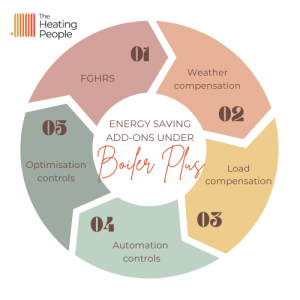
Diagram showing Boiler Plus.Thanks to the Boiler Plus Regulations, all new combi boilers must be at least 92% efficient.

Combi boilers must also have one of four additional energy saving measures installed.

But the performance of combi boilers is where dramatic improvements have been made.

Advancements in technology mean that combis now use an electrical operation process, rather than a mechanical one.

This means that the old problems with the delay in delivery of hot water is a thing of the past.

With no water tank to heat up, combi boilers can provide an unlimited supply of hot water on demand.

This is ideal in busy homes where showers may be used back to back each morning. It also means no more waiting for water to heat up for your bath. A combi is ready when you are!

Central heating myth 5: Combination boilers are not suitable for larger homes

Another common misconception about combi boilers is that they are not suitable for heating larger homes.

But this isn’t true, even the smallest combi boiler will comfortably heat the vast majority of larger homes.

This assumption about house size and combi boilers stems from the way in which they work.

As explained above, combis provide instant hot water to taps and showers by heating water directly from the mains.

This is different from heat-only and system boilers which store hot water in a cylinder.

Combis deliver strong water pressure to one tap (or shower) at a time. But if multiple outlets are being used at once, the pressure can weaken.

This means that combi boilers are best suited to homes with relatively small hot water demands at any one time.

But this doesn’t mean that a combi cannot heat a larger home.

The real drivers for determining the best type of boiler, is by establishing:

  • the heat load of your property;
  • how many bathrooms you have; and
  • how you use your domestic hot water.

How do you use your hot water?

The number of bathrooms is a better indicator than the overall size of the house.

For instance, if you have a large house with just one bathroom, where the shower will be used consecutively each morning, then a combi may be fine.

But, if you have multiple bathrooms and everyone wants showers at the same time; then a combi won’t be suitable.

In this case a heat-only or system boiler might be your better option.

Some manufacturers also offer storage combi boilers. These boilers have a hot water cylinder within the unit itself. This allows them to meet a higher demand for heating and hot water than a standard combi.

For tailored advice on what type of boiler is right for you, contact one of our experts today.

Central heating myth 7 – Painting your radiators makes them more efficient

A mother and child by a radiator.Some people make the mistake of thinking that painting radiators black will make them more effective at transmitting heat. But please don’t do this!

In reality, painting your radiators will have the opposite effect. Paint will stop heat being dispersed as easily, making them less effective.

You should also avoid placing any large furniture in front of your radiators. And don’t hang your washing on them either – invest in a clothes airer instead.

If you’ve noticed cold spots on your radiators, they may need need bleeding. Check out our step-by-step guide on how to do that, here. And if you really want to improve their efficiency, consider installing TRVs.

Final thoughts

We’ve hoped that we’ve managed to dispel some common heating myths here!

For tailored advice on improving your heating system, contact us today.

Useful Links

https://energysavingtrust.org.uk/advice/thermostats-and-heating-controls/

Categories
Boiler types

Pros and cons of heat-only boilers

A woman looking at a diagram of a heat-only boiler.Heat-only boilers are a good choice for larger households with multiple bathrooms because they can meet a high demand for hot water.

Somewhat confusingly, they’re known by a few different names.

You might know heat-only boilers as ‘regular’ or ‘conventional’ boilers. These names reflect the fact that they’re often viewed as the traditional way of heating a home. 

In the industry, they’re commonly referred to as ‘heat-only’ boilers, because they produce hot water for your central heating, but use a separate hot water cylinder to produce hot water for your taps, baths, and showers. 

In this blog, we’ll explain what a heat-only boiler is, and discuss their major pros and cons. Hopefully this will help you to decide whether a heat-only boiler might be a good option for you.

What is a heat-only boiler?

When you’re considering replacing your boiler; one of the first things that you’ll need to decide is what type of boiler you want.

There are three main types of boilers that you can choose from: combi boilers; system boilers; and heat-only boilers.

Combi boilers are compact all-rounders that produce both your heating and hot water from one unit; without the need for external tanks or cylinders. This makes them a popular choice for homes that are short on space. 

A system boiler provides your heating and hot water using the boiler itself; and an additional cylinder for storing hot water.

A heat-only boiler provides heating directly to your central heating, and works with a cylinder to provide your hot water. They can be ‘open-vented’, meaning that there’s a feed and expansion tank in the loft. But they can also work on a ‘sealed’ system too.

How do heat-only boilers work?

Diagram of a heat-only boiler system.Heat-only boilers are usually installed as part of an open vented system.

In addition to the boiler itself, there is a cold water cistern (sometimes called a header tank); a small feed and expansion tank; and a hot water storage cylinder.

The cold water cistern and the feed and expansion task; are installed in the highest part of the home (usually a loft or attic). And the hot water cylinder is usually installed in an airing cupboard.

The cold water cistern receives its water from the mains. With the help of gravity, it supplies the cylinder with cold water which is then heated by the boiler.

The hot water is stored until it’s needed to heat your radiators or supply your taps and showers.

The purpose of the feed and expansion tank is to maintain the correct level of water for the heating system. It allows for the water expansion when the heating is switched on.

Let’s look at how heat-only boilers are different from the other two types of boiler.

How are heat-only boilers different from system boilers?

Heat-only boilers are sometimes confused with system boilers because both boilers store large quantities of hot water in a cylinder.


The key difference between them; is that a heat-only boiler is supplied with cold water from the storage cistern (usually kept in the loft). Whereas a system boiler takes its cold-water supply directly from the mains.

Both heat-only and system boilers are good options for homes with a high demand for hot water. Because they store hot water and can therefore support multiple outlets being used at the same time.

You might like to read our related blog: Pros and cons of system boilers.

How are heat-only boilers different from combi boilers?

A combi boiler is different from heat-only and system boilers because it’s an all-in-one unit. It doesn’t need any external tanks or cylinders.

A combi takes its cold-water supply directly from the mains and heats it instantaneously on demand.

Since combi boilers don’t have a large store of hot water; they’re generally better suited to small to medium-sized homes which use less hot water.

You might like to read our related blog: Pros and cons of combi boilers.

Pros of heat- only boilers

Despite being one of the oldest types of boilers, heat-only boilers still offer lots of benefits for home heating:

Pro: Heat-only boilers can meet high demand for hot water

A child and dog covered in mud.The main advantage of heat-only boilers is that they can meet a high demand for hot water.

Combi boilers struggle where different family members want to shower or use hot water at the same time. This is because combis heat water from the mains instantly on demand.

Unlike combi boilers, heat-only boilers store a large quantity of hot water in a cylinder. So, they’re able to supply multiple taps and bathrooms at the same time, without losing pressure. As such, they’re a good choice for larger households and commercial premises.

Pro: Heat-only boilers are effective in areas with low pressure

Heat-only boilers are also a good choice in areas with low water pressure. This is because the cold-water cistern (usually installed in the loft) feeds the cold water to the boiler by gravity.

Gravity-fed systems don’t need good water pressure to work. This makes heat-only boilers an ideal choice for regions where the water pressure is too low for a combi boiler – which is fed directly from the mains supply.

Pro: Heat-only boilers are compatible with renewable technology such as solar power

solar panels

Another advantage of heat-only boilers is that they can be integrated with renewable heating systems. This can save you money whilst helping the environment.

Solar thermal heating systems use free heat from the sun to heat your water; rather than burning gas which you have to pay for.

If you’ve read our blogs on what the government is doing to tackle climate change; and the outcomes of COP26; you’ll know that the increased use of renewables is vital in our ambition to achieve Net Zero.

Pro: Heat-only boilers are compatible with immersion heaters in case of a breakdown 

A cold couple sitting by a radiator.Another bonus of having a heat-only boiler over a combi; is that it can have an electric immersion heater fitted to its hot water cylinder.

An immersion heater is an element that goes inside the cylinder and heats it up. It can act as a backup and heat your water instead of your boiler. This is handy because it means you won’t be left without hot water if your boiler ever suffers a breakdown.


Cons of heat-only boilers

There are some drawbacks to heat-only boilers, which you also need to consider:

Con: Heat-only boilers take up a lot of space

Out of the three types of boilers that are available, heat-only boilers take up the most space in your home.

In addition to the boiler itself; this setup requires space for a hot water cylinder, which is usually housed in an airing cupboard; plus room for two tanks in the loft (a cold water cistern and a feed and expansion tank).

This means that a heat-only boiler may not be suitable for flats or homes that have had a loft conversion.

Con: Heat-only boilers can temporarily run out of hot water

Since heat-only boilers store hot water to be used when needed; the amount of water that they can supply is limited by the capacity of your hot water cylinder.

After the water stored in the hot water cylinder is used up; you’ll need to wait for the boiler to heat up more water.

This potential problem can be minimised by choosing an expert engineer. They will recommend and install the correct size boiler and cylinder.

Con: Heat-only boilers are less efficient than other boiler types

Diagram of the 3 types of boiler.Unfortunately, heat-only boilers are generally the least efficient type of boiler because they have the fewest control options.

They can also be less efficient because if you don’t use a lot of water. Because you may waste energy by heating a surplus in your cylinder. This doesn’t happen with a combi; which will only provide the amount of hot water you need.

If your hot water cylinder isn’t insulated, you’ll also be wasting lots of energy through heat loss. If you’ve ever noticed how warm an airing cupboard is, you’ve experienced heat loss from a hot water cylinder!

This problem can be reduced by fitting a hot water cylinder jacket . This reduces the rate of heat loss and keeps your water warmer for longer.

You might like our related blog: How to choose an energy efficient boiler.

Final thoughts…

A man looking at different doors.Heat-only boilers are best suited to larger homes with multiple bathrooms; where several people all want to wash and shower at the same time.

Whilst you’ll need plenty of space to house the component parts; they’re a good choice for areas that suffer from low water pressure.

For tailored advice on which type of boiler would be best for your needs; contact one of our friendly team today.

 Useful Links

Vaillant: Heat-only boilers

Categories
Worcester Bosch

Why choose a Worcester Bosch boiler?

A Worcester Bosch Greenstar boiler Why choose a Worcester Bosch boiler…

If you’re in the market for a new boiler and have done even a basic Google search for boiler manufacturers, you’ll have come across Worcester Bosch – they’re the current market leaders for domestic boilers.

But why is this? If you want to know why so many people seem to think Worcester Bosch is the best choice when it comes to replacing their boiler, then this blog’s for you!

The Heating People aren’t tied to any particular manufacturer of boilers, we can work with all of them.

That being said, we particularly rate ATAG; Worcester Bosch; Vaillant and Viessmann. Each of these manufacturers have boilers in their ranges that we would highly recommend.

But today, we’ll take a closer look at why so many customers rate Worcester Bosch, and why they’re a good choice for your next boiler.

Should I choose a Worcester Bosch boiler because they’re a popular consumer choice?

An engineer and a customer next to a boiler.Before we get into why so many people like Worcester Bosch, we want to address this question. Should you pick a Worcester Bosch boiler because everyone else seems to like them?

In a word, no!

Worcester Bosch is undoubtedly an excellent choice for a new boiler, for all the reasons we’ll soon get into. We’re proud to be Worcester Bosch Accredited Installers.

But Worcester Bosch is not the only excellent choice. That’s why getting a new boiler can be overwhelming!

There are many reputable boiler manufacturers that make reliable and efficient boilers that stand the test of time.

And you shouldn’t pick a boiler based on what everyone else seems to be getting. You need to make sure that the choice you’re making suits your particular wants and needs.

Although ATAG is a bit of a dark horse in the domestic boiler market at the moment, their engineering is outstanding, and they’re producing the most efficient boilers in Europe.

So, it’s important to do a bit of research on all of the brands that you’re interested in, so that you can see the benefits that each of them brings to the table.

That being said, let’s take a look at who Worcester Bosch are, and why they’re so popular…

Who is Worcester Bosch?

Worcester was founded in 1962 and became part of the Worldwide Bosch Group in 1996. They are the current market leader for domestic boilers.

But they don’t just make boilers.

Bosch boasts a huge product range including gas and oil boilers; hydrogen ready boilers; hot water cylinders; renewable technologies such as heat pumps and solar water heating systems; and smart controls. 

Worcester Bosch has been consistently recommended by Which? for both their gas and oil boiler ranges and have even supplied boilers to Her Majesty at The Queen’s Sandringham Estate.

Why should you consider a Worcester Bosch boiler?

So, what is it about Worcester Bosch, in particular, that makes them a good choice for your replacement boiler?

1.    Worcester Bosch has an extensive product range

You don’t need to worry about whether Worcester Bosch will have a boiler to meet your needs, because whatever your requirements, they’ve been catered for!

Worcester Bosch has a boiler to suit just about any home and lifestyle.

Whether you’re looking for a heat-only; system; or combi boiler; you’ll have plenty of options in terms of sizes and outputs.

It’s vital not to oversize your boiler ‘just in case’ because this will cost you on your energy bills.

But – if you do need a lot of power, Worcester Bosch has the most powerful wall hung boiler on the market, with outputs of up to 50Kw.

One of our favourite combi boilers (across all brands) is the Worcester Bosch Greenstar 4000.

New for 2021, the Greenstar 4000 is the new and improved successor to the hugely popular Greenstar i.

Worcester describe the Greenstar 4000 as being ‘instantly familiar and yet totally transformed’ because it features many of the much-loved features of the i series, whilst boasting improvements in speed and ease of installation; commissioning and servicing; alongside improvements in efficiency and control.

2.    Worcester Bosch has some of the most stylish boilers on the market

Ok, so this is a bit of a shallow one, but if you’re after a stylish looking boiler that you don’t want to hide in a cupboard, Worcester Bosch is a good choice.

Up until recently, boilers have been thought of as ugly white boxes that are hidden away out of sight. But Worcester Bosch have turned that on its head, by designing their Lifestyle range of boilers.

These design-led boilers look more like an iPhone than a boiler. The Style even comes in either a high gloss black or white, with a touch screen!

The Lifestyle range was launched in May 2019 and is made up of two different models, the Worcester Bosch Greenstar 8000 Life and the Greenstar 8000 Style, both of which are available in a wide range of output sizes to cater for any home.

But don’t be fooled by their fashionable appearance, behind the glossy exterior, lies a lot of power. With power outputs of up to 50kw – this is the most powerful wall hung boiler on the market.

3.    Worcester Bosch boilers are energy efficient

Worcester Bosch boilers are well known for their outstanding efficiency.

Efficient boilers are desirable because they save you money on your energy bills, as well as being better for the environment.

Energy efficiency is a top priority for all boilers, and the Boiler Plus Regulations require that new boilers have an energy efficiency of at least 92%.

All Worcester Bosch boilers are ErP A-rated for efficiency.

And according to Worcester Bosch, adding a Bosch EasyControl internet-connected Smart controller to their Greenstar range of boilers can further boost your heating system efficiency to an impressive 98% (also known as A+).

Both Lifestyle boilers (which we mentioned earlier) are 94% energy efficient and have an increased modulation ratio (1:10), in order to improve fuel efficiency, user comfort and boiler longevity by preventing on/off cycling.

You might like our related blog: How to choose an energy efficient boiler.

4.    Worcester Bosch offers extensive guarantees for your peace of mind

Worcester Bosch boilers are also renowned for their reliability. Nonetheless, they come with substantial guarantees for your peace of mind.

When fitted by Worcester Bosch Accredited Installers, such as The Heating People, Worcester Bosch boilers boilers come with guarantees of up to 12 years. This covers all aspects of the boiler, so should anything go wrong, it will be repaired free of charge.

Just remember that you’ll need to have your boiler serviced every year with a Gas Safe engineer to maintain its guarantee, whichever manufacturer you choose.

5.    Worcester Bosch is highly rated by customers

Worcester Bosch has built up a solid reputation with consumers over the last 50 years.

Which has helped Worcester Bosch to become a household name by awarding them the highest brand score for nine years running.

In the Which? Best Boiler Brands Report in 2020, Which? Said: ‘Worcester Bosch performs so consistently well in our annual reliability surveys that its name is synonymous with dependability.’ Quite the accolade.

Worcester Bosch has an impressive 4.6 star rating from over 27,000 consumer reviews on Trust Pilot.

And YouGov have ranked Worcester Bosch as the UK’s best value boiler brand, the most recommended boiler brand and the best quality boiler brand.

6.    Worcester Bosch has innovative technology

Worcester Bosch boilers integrate with smart technology for your convenience.

Many Worcester boilers are Smart compatible and can be connected to a range of different Smart thermostats including the Bosch EasyControl, and other third party controls such as Nest.

These user-friendly smart controls enable you to control your heating and hot water from wherever you are, from your smartphone.

With the latest technology, controls such as the Bosch EasyControl can help you to save money on your energy bills by automatically adjusting your heating when you go out. The smartphone app will even show you a graph of your gas consumption, so you can be in better control of your bills, and avoid nasty surprises.

How much do Worcester Bosch boilers cost?

The cost of a Worcester Bosch boiler depends on the type of boiler you need – combi; heat-only; or system; as well as the size (power output) of the boiler that you need.

Other factors such as how much work is involved in the installation of your new boiler will also have an impact on the price you pay.

For example, the cost will be lower (because there is less work involved) if you are making a straight swap for the same type of boiler mounted in the same position.

But as a general guide, Worcester Bosch gas boilers cost between £570 and £1,500, depending on their type and size. The Worcester Bosch Lifestyle boilers are a premium option and retail for around £1,800 to £2,400.

Final thoughts…

When you choose Worcester Bosch, you’ll have an excellent choice of boilers and controls to meet any heating requirements, from a highly reputable company.

You can rest assured that your boiler will be highly economical and will come with a hefty guarantee.

To find out if a Worcester Bosch boiler is right for you, call us today to book your free survey.

Useful Links:

Worcester Bosch: About – history

Trust Pilot reviews of Worcester Bosch

Categories
Energy efficiency

FGHRS

Cycling arrows.FGHRS or ‘Flue Gas Heat Recovery Systems’ are energy saving devices. They allow your boiler to reuse or ‘recycle’ heat that would otherwise be wasted as gases out of the flue.

We know that recycling is good for our wallets and the planet; so it probably won’t surprise you to learn that it’s good for our boilers too!

This means that you’ll need to burn less fuel to heat your home. Thereby saving you money on your energy bills, whilst also reducing your carbon footprint.

Using FGHRS is one of the four ways that new combi boilers can comply with the ‘Boiler Plus’ legislation.

Read on to find out everything you need to know…

What does Boiler Plus say about FGHRS?

Diagram showing Boiler Plus.Boiler Plus is a new (ish) set of rules on energy efficiency; which improves the way we use energy in our homes.

From April 6th, 2018, all boilers must now have a minimum ErP (Energy related Products) rating of 92%. And all gas and oil boilers must have appropriate time and temperature controls fitted.

In addition, when installed, combi boilers must have one of four energy saving devices fitted – one of which is FGHRS.

So, if you’re in the market for a new combi boiler; a boiler with this energy saving device might be a good option.

Some combi boilers have FGHRS built-in

In some cases, you don’t even need to consider whether to add FGHRS as an add-on to your boiler; because the boiler itself comes with the technology built-in.

Two of our favourite combi boilers are the ATAG iC Economiser Plus and the Vaillant EcoTEC Exclusive with Green iQ. Because they have built-in FGHRS, and  are automatically compliant with Boiler Plus.

You might like our related blog: How to choose an energy efficient boiler.

What is FGHRS?

FGHRS are energy saving devices that make boilers more efficient by capturing and reusing the waste heat from your boiler. This would otherwise have escaped out of your flue or chimney.

Your boiler produces fumes when running. A flue takes these fumes safely out of your home through a wall or your roof.

The flue gases are hot, and letting them go straight out into the atmosphere is a waste of up to 35% of the heat that your boiler is producing.

A boiler with FGHRS recycles hot flue gases that would otherwise be wasted to preheat the cold water entering the boiler.

Before the hot gases go outside; they go through a heat exchanger, where incoming cold mains water gets warmed up by the gases. This lowers the amount of energy needed to warm the water up for your heating system.

In the time it takes for the incoming water to pass through the heat exchanger; the water temperature rises from around 10°C; to between 20-40°C.

This means that your boiler doesn’t have to work as hard to heat the water. The much cooler flue gases are then vented out. 

What are the benefits?

Lets take as look at what you stand to gain from this energy saving device:

FGHRS reduces your fuel consumption – and therefore your energy bills

Where FGHRS is fitted on a modern boiler, it will need to burn up to 7% less gas. But will deliver the same amount of heat.

This is because the cold water is being ‘pre-warmed’ by gases which would otherwise have been wasted. So, your boiler isn’t having to use as much energy to get cold water hot.

If FGHRS is added to an older non-condensing boiler, the fuel savings are even more significant. You could save up to 52% on a G rated boiler, and up to 35% on an older combi boiler.

By reducing your fuel consumption, you’ll reduce your energy bills.

FGHRS reduces your carbon footprint

As well as saving you money on your energy bills; using FGHRS will also reduce your carbon footprint, which is good news for the planet too!

The Boiler Plus regulations; which recognise FGHRS as being one of four important energy saving devices; were created as part of the government’s strategy to reach net-zero by 2050.

As part of the consultation process leading up to the implementation of Boiler Plus; independent tests were presented to the Government. They found that if half a million FGHRS were installed in homes; 56,209,150m3 of gas would be saved; and 114,734,118kg of carbon dioxide emissions saved.

It’s a low maintenance option

It’s straightforward for Gas Safe engineers to fit FGHRS. And once installed, you can just forget about them, and let them do their thing!

Older boilers can have FGHRS fitted

Older non-condensing boilers do not have any sort of built-in FGHRS. And their efficiency can be as low as 65%, which means they’re bad for your wallet and the environment.

If you have an old G-rated model, you’re probably best replacing it with a new boiler.

But it’s possible to increase the efficiency of your current boiler by attaching FGHRS.

If you choose this option, you’ll need space above your existing boiler to fit the system. These systems cost around £600. But according to the Energy Saving Trust, you could save up to £100 on your fuel bills each year.

If you’re thinking about a boiler replacement, contact us today for tailored advice on what the best options are for you.

How much do external ‘add-on’ FGHRS devices cost?

External or ‘bolt-on’ devices can cost from £500 – £800, depending on the type of boiler you already have.

Whilst you will see energy savings, it may take many years to recover this cost.

It might be a better option to consider replacing your old boiler with a more efficient one with integral FGHRS; such as the ATAG and Vaillant models we mentioned earlier.

A like for like replacement of an older combi for a new combi with built-in FGHRS; starts from £2500, depending on your current system, and chosen model.

To discuss your options, contact one of our friendly team at The Heating People.

Useful Links:

Government report: Boiler Plus

Energy Saving Trust advice on boilers

The Greenage article on FGHRS

Worcester Bosch FGHRS

ATAG Heating – ATAG iC Economiser Plus

Categories
Advice

A brief history of central heating

A brief history of central heating…

When it comes to keeping warm, we’re a bit spoilt.

Our heating systems are so good, we don’t even give them a second’s thought most of the time. They’re the unsung heroes of our home, keeping us comfortable all year round.

And not only that, they’re smart too. We live in a time where our heating systems can actually ‘learn’ things about us – from what temperature we like, to our daily schedule.

With geo-fencing technology, they can even tell when we’ve left the house, or are about to return, so that they can get the temperature just to our liking – without us lifting a finger! But it wasn’t always like this!

We’ve come a long way from the campfires of early man.

In this blog, we look back at the history of central heating. So we can really appreciate how far we’ve come – and where we may be headed in the future.

As you’ll appreciate, the history of central heating across the world is a long one, so we’ll keep it to the brief and edited highlights!

Ancient heating

Campfires were used for heating and cooking.

These fires began outside, but were eventually moved inside the home, when it was realised that openings in the roof would allow the smoke to escape. 

5000 BC

Although we tend to think of underfloor heating as a modern invention, the very first form of underfloor heating dates back thousands of years to North Korea.

Known as an ondol – meaning ‘warm stone’, homes were warmed by allowing the fire in the furnace of a kitchen to pass under the room’s floor to keep it warm.


2500 BC

The Ancient Greeks invented the first fixed central hearths for keeping homes warm.  

The hearth commonly stood in the middle of the room, with the smoke rising through the room to a smoke hole in the roof.

The hearth was used for cooking on, as well as keeping the home warm. Such was the significance of the hearth to the home, Greek and Roman mythology features goddesses of the hearth, Hestia and Vesta.

1500 BC 

The Ancient Egyptians introduced bellows which created a strong blast of air to fan the flames and enhance the heat of fires. But the first real central heating system didn’t come along until the Romans. 

350 BC – The Romans

It’s nigh on impossible to talk about the inventions of the Romans without thinking of the infamous line in Monty Python’s Life of Brian:

“All right, but apart from the sanitation, the medicine, education, wine, public order, irrigation, roads, a fresh water system, and public health, what have the Romans ever done for us?”

But we could certainly add to it –  invented the first central heating system!

The Roman Empire invented a heating system called a “hypocaust” for heating hot baths and other public buildings in ancient Rome.

Roman buildings with a hypocaust were built on pillars and the floors and walls had spaces in them.

By lighting fires below the buildings, heat could flow through the space in the floors and walls, and out through flues in the roof.

476 AD – The Collapse of Ancient Rome

The fall of the Roman Empire saw the decline in the Hypocaust, and home heating largely reverted to being handled by fireplaces in individual rooms. It wasn’t until around 1,500 years later that central heating was reintroduced.

800 AD – The Early Middle Ages

During the Middle Ages, both stone and clay ovens were used.

The 12th century – Invention of the chimney

The first chimneys were constructed in castles. The earliest extant example of an English chimney is at the keep of Conisbrough Castle in Yorkshire, which dates from 1185 AD.

The 13th century

In the late 13th century, chimneys in domestic homes started to make an appearance.

Holes in rooves that had previously been used to allow smoke from the hearth to escape were enclosed by a board, known as louvres.

These boards were made of horizontal wooden planks, fixed diagonally and an opening for the smoke to escape.

The 15th century

The first masonry stoves were built.

The 17th century

The wood burning fireplace was the primary means of heating a home. Louis Savot of France invented the raised grate and designed a circulating fireplace in the early 1600s.

The 18th century

1741 – Benjamin Franklin invented a safe, efficient stove.

Benjamin Franklin wanted to improve the efficiency of the fireplace.

He created a metal-lined fireplace known as the ‘Franklin Stove’ that transferred more heat to a room than any previous inventions.

His theory about heat was that it acted like a liquid, in that it wanted to rush out of a room, unless it was contained.

1745 – William Cook first proposed the concept of steam heating.

 William Cook was the first to propose steam heating in 1745 in England.

1790 – Steam engine pioneers Matthew Boulton, and James Watt used steam heating in their homes

Boulton and Watt used a central boiler and a system of pipes to develop the first working steam-based heating system for their homes.

The 19th century – The Industrial Revolution

And this is where it all really took off…

1802 – Zachaus Winzler developed the first gas stove

With the Industrial Revolution, came advances in fuel technology and the advent of gas. A major improvement in fuel technology came with the advent of gas. James Sharp patented a gas stove.

1805 – William Strutt invented a warm-air furnace

William Strutt created a furnace with a wrought iron air chamber, surrounded by stone to create both cool and warmed air.

1830 – Andre Ure invented a bimetal thermostat

Ure’s thermostat was based around a strip made of two different metals that would bend when a room reached a certain temperature, triggering a switch to turn the heating system on, or off.

1854 – Stephen Gold created the ‘mattress radiator’

Gold’s radiator was a device made of two dimpled iron sheets that were riveted together at the dimples, making it look like a mattress.

1855 – 1857  Franz San Galli invented the radiator

Prussian inventor Franz San Galli invented a radiator which he patented as the “hot box”.

The hot box was made up of large columns of steel with waterways inside that allowed for hot water to pass through and heat air which in turn heated up the room.

This was a revolution in central heating and was launched in St Petersburg.

1863 – Joseph Nason and Robert Briggs developed the radiator

Nason and Briggs developed a new design of radiator that used vertical wrought iron tubes screwed into a cast iron base. This is a predecessor to the radiator that we know today.

1870 – John Mills invented a successful watertube boiler.

Mills patented his sectional boiler for steam or hot water. 

1872 –  Nelson Bundy invented the ‘Bundy Loop’

Bundy invented the first popular cast iron radiator that had loops screwed into a cast iron base.

Cast iron sectional radiators were widely used by the 1880s.

1883 – Thomas Edison invented the first electric heater

The earliest electric heaters used bulbs. Thomas Edison patented the lightbulb in 1880.

1885 – Coal surpasses wood as the primary fuel in the developed world and the Bunsen burner is invented

The Bunsen burner was the first time that people were able to regulate a gas flame. This was a precursor to modern gas heating systems.

The 20th century

1906 – Honeywell introduced homeowners to the very first thermostat

William. R. Sweatt designed the first home thermostats that were stamped with “Electric Heat Regulator Co” and were in a semicircle shape. This was later developed into the Honeywell Round thermostat, known simply as The Round.

1919 – Alice Parker patented the first central heating system

Alice Parker was an African American inventor who patented her system of central heating using natural gas.

1923 – Dr. Richard Seligman invented the plate heat exchanger

Seligman found that by using two different metal plates, he could transfer heat from a hot fluid to a cold fluid. This ‘heat-exchanger’ is found in nearly every boiler today.

1930 – Engineers developed fibreglass insulation.

The first fibreglass insulation consisted of extremely fine glass fibres, inside rolls for easy installation.

1937 – The Victorians embraced radiators as aesthetic items as well as functional ones

The Victorians who could afford opulent homes saw radiators as being statement pieces for the home, as well as being functional for heating. Cast iron radiators featured intricate scrolled detail.

1948 – Robert C. Webber invented the direct exchange ground-source heat pump

American inventor Robert C Webber came up with the idea of a ground source heat pump when experimenting with the efficiency of a deep freezer.

1967 – Vaillant invented the first combi-boiler

Vaillant invented the first combi boiler, the ‘Combi-Geyser VCW 20’. For the first time this combined heating and hot water supply in a single unit.

1970’s – electric air-to-air heat pump and solar energy became widely adopted.

The availability of oil and natural gas was problematic in the 1970s. So electric air-to-air heat pumps and solar energy were touted as a solution to the energy crisis.

1980s –  Central heating was commonplace

There was an improvement in public health as central heating became commonplace.

The design of homes started changing, with open-plan rooms becoming popular; due to the reduced need to have lots of individual rooms with closed doors to keep the heat in.

The fireplace was no longer the focal point of the room.

The 21st century

2005 – Condensing technology became mandatory on all new boiler installations

Since 2005, all new boilers installed must have condensing technology.

2007 – Stuart Lombard invented the first smart thermostat called the ecobee

Stuart Lombard combined programmable thermostats and WiFi connectivity, making it possible to remotely control your central heating.

2018 – Boiler Plus regulations

Diagram showing Boiler Plus.The Boiler Plus regulations came about following a public consultation into the future of heat in domestic buildings by the Department for Business, Energy and Industrial Strategy (BEIS) in December 2016.

All boilers must meet this standard for energy efficiency.

[sc name=”image-close” ][/sc]

2020 -Boris Johnson’s 10 point plan for a ‘Green Revolution’

In November 2020, Boris Johnson published ‘The Ten Point Plan for a Green Industrial Revolution’. This sets out the government’s priorities for £12bn worth of investment in clean energy; transport; and energy efficiency; to meet the target net zero emissions by 2050.

It means that in the future we’re likely to see a combination of both heat pumps and hydrogen boilers in homes over the coming years to achieve the government’s targets to reduce climate change.

Final thoughts?

So, what’s clear from this timeline, is that today’s home heating systems have evolved from ideas spanning back decades, and from all around the world.

Thanks to forward-thinking engineers everywhere, we have access to safe heat at our fingertips, and even remotely from our smartphones.

Initially, the challenge was just to develop the technology as part of the Industrial Revolution.

But now we face a new challenge. To continue evolving our technology, but in a more sustainable way.

Over the coming years, we can expect to see the advancement of even greener boilers; heat-pumps; solar; and hydrogen powered heating taking us into the next century.

Useful Links:

QS Supplies: History of heating timeline

Britannica: Hypocaust

BBC News: What has heating done for us?

Statistica: Central heating in households in the UK

Eon Energy: The evolution of heating

Homeserve: A brief history of boilers

Medieval EU: Open hearths

Romae-vitam: hypocaust

Historic England: Open fires

Britannica: The Industrial Revolution 1750-1900

Categories
Heating controls

What are heating controls?

What are heating controls?

Heating controls are a vital part of your heating system. They they allow you to keep your home at a comfortable temperature without wasting energy or money.

Sounds simple enough, but if you’re confused by all the jargon, it’s hardly surprising.

Although heating controls have been around for a long time; we’ve come a long way from the simple thermostats of the past.

Demand for providing better comfort and economy; as well as reducing damage to the environment, means that there’s a lot of choice out there.

From thermostats, TRVs, programmers, smart controls, weather compensation controls, it’s difficult to know what’s best.

In this guide, we explain the benefits of using heating controls; and give you a brief overview of the different types of heating control that are available.

Why are heating controls important?

Heating controls are important for two main reasons.

Firstly, they keep you in control of your comfort and your energy bills; and secondly, they help you to reduce your carbon footprint.

Heating controls allow you to keep your home warm and cosy; whilst simultaneously keeping your energy bills as low as possible.


What are the benefits of using heating controls?

Here are some of the main benefits of using heating controls:

Heating controls will save you money on your energy bills

A woman and a piggy bank on a radiator.If you were to just turn your heating up to full blast in the winter, hoping for the best; this would trigger a huge (and unnecessary) energy bill.

When you think about it, you don’t need the heating to be on full blast 24/7 to be comfortable. And you probably don’t need all your rooms to be always at the same temperature.

Do you even use all the rooms that you’re heating?

According to the Energy Saving Trust (EST), if you live in a typical three-bedroom house without any controls; and then you were to install and correctly use a programmer room thermostat; and thermostatic radiator valves; you could save £75 a year, whilst still being perfectly comfortable.

You might like our related blog: Does smart heating save money?

Heating controls reduce your carbon footprint

We have come dependent on our boilers to keep us warm and comfortable all year round; and to keep up with our demands for hot water.

But to produce heating and hot water for us, boilers need to burn fuel, usually gas.

Unfortunately, the by-products of burning the fuel are damaging to the environment. When we use our boilers, we release some Carbon Dioxide (CO2) from our flues into the atmosphere.

CO2 is one of the main greenhouse gases which causes climate change. According to the Energy Saving Trust, around 45% of the UK’s man-made CO2 emissions come from energy we use at home and in our cars.

The UK is committed to reducing our emissions to net-zero by 2050. And that’s where an efficient boiler and appropriate heating controls comes in.

Heating controls can help you to reduce your carbon dioxide emissions, by making sure that you’re only using your heating when necessary; in rooms that you use; and up to the temperature you want.

This means that you’ll be burning less fuel and reducing your emissions.

According to the Energy Saving Trust, you can save 320kg of carbon dioxide a year by installing and correctly using a programmer, room thermostat and thermostatic radiator valves.

And if you turn your thermostat down by just one degree, you can save a further 310kg of carbon dioxide a year!

Heating controls are more convenient and improve your comfort

Heating controls make your heating work for you and your schedule. They allow you to schedule your heating and hot water to go on and off when needed.

You’ll have the peace of mind in knowing that your home will be nice and cozy when you get home from work, without wasting energy heating an empty home.

You’ll also find that your home is a more consistent and comfortable temperature because heating controls avoid the unpleasant situation where you have spikes in over and underheating.

Another advantage with heating controls is that you can select areas of your home to heat and the required temperature for each room, rather than having the whole house heated to the same temperature.

This is perfect if you have family members who like a different temperature to you, or you have rooms that are rarely used.

What does Boiler Plus say about heating controls?

Diagram showing Boiler Plus.Boiler Plus is a new(ish) set of rules on energy efficiency designed to improve the way you use energy in your home. They came into force in April 2018.

Boiler Plus gives you greater choice and control over your energy usage, which results in savings on your energy bills.

From April 6th 2018, all boilers must now have a minimum ErP (Energy related Products) rating of 92% and all gas and oil boilers must have appropriate time and temperature controls fitted.

In addition, when installed, combi boilers must have one of four of the following requirements fitted:

  • Flue Gas Heat Recovery – a system that enables the boiler to reuse heat that would have otherwise been wasted
  • Weather compensation – flow temperature can be modulated based on the outside temperature
  • Load compensation – flow temperature can be modulated from the boiler based on room temperature
  • Smart controls with automation and optimisation functions

Any boilers installed without the measures set out in the Boiler Plus standards, will be non-compliant with the Building Regulations.

So, Boiler Plus has made it mandatory to have time and temperature heating controls fitted to all boilers and combi boilers must also have an extra energy-saving device, which could be smart controls.

How does a heating control work?

A woman thinkingBroadly speaking, heating controls achieve energy savings in one of two ways:

  1. Increasing the energy efficiency of the boiler; or
  2. Reducing the amount of heat that is wasted.

There are lots of different types of heating controls (more on this later!) But at its simplest, when you set your thermostat to the temperature you want, your boiler will come on when the room temperature falls below this and will switch off when the desired temperature is reached.

More sophisticated compensation smart controls will adjust the output of the boiler up and down in small increments to meet the room temperature exactly. These save energy and reduce fuel bills.

Can I upgrade or install heating controls without replacing my boiler?

You can upgrade or install heating controls without replacing your boiler, and it’s a particularly good idea to think about this if your controls are more than 14 years old. Room thermostats, for example, are much more accurate now than they used to be.

What types of controls are there?

There are a huge variety of heating controls available, but we’ll talk you through some of the main ones:

Time switches

Time switches are the simplest type of control because they simply turn your boiler on and off at preset times.

Generally, time switches offer on and off timing options over 24 hours only. So, if you wanted the heating to come on at 7 am and turn off at 10 pm every day of the week, a basic timer could do this.

However, if your days can vary, and you want to be able to make last minute plans, they wouldn’t be suitable.

Time switches are generally not used on modern systems where more appropriate programmable thermostats or compensating control is used.

Time switches can be useful for hot water systems though.

Programmers

Programmers automatically switch your heating off when you’re not at home, or when you don’t need it, by allowing you to set ‘on’ and ‘off’ time periods.

Although programmers sound similar to time switches, programmers allow you to set your heating and sometimes hot water to switch on and off at different times on different days of the week (rather than only over a 24 hour period).

Again, a basic programmer is generally not used on modern systems where more appropriate programmable thermostats or compensating control is used.

Room thermostats

Room thermostats turn the heating on until the room reaches the temperature you have manually set and then off until the temperature drops below your desired temperature.

You don’t need to turn your room thermostat up when it is colder outside; the house will heat up to the set temperature whatever the weather but might take longer on cold days.

The Heating People generally recommend a programmable room thermostat over this option.

Programmable room thermostats

Programmable room thermostats have a built-in timer which lets you schedule your heating to come on and go off automatically at different times of day.

Unlike the standard room thermostat, you won’t have to manually adjust the heating. Once set, it will automatically switch your heating on and off, according to your daily routine.

You can have different temperatures in individual rooms by installing thermostatic radiator valves (TRVs) on individual radiators.

Programmable room thermostats can be added to your existing heating system for as little as £150, with little disruption.

Smart thermostat

The word ‘SMART’ stands for “Self-Monitoring Analysis & Reporting Technology”, and covers a large group of controls.

They connect to the internet and can be controlled remotely through a tablet or smartphone. This means that you have much greater control over your heating, from wherever you are, at any time of day.

To give you an idea of what these devices can do, we’ll look at some key features of some popular smart thermostats:

Nest learning thermostat

  • ‘Auto-Schedule’ where the control learns from you and programs itself.
    • Energy history – allowing you more control over your bills.
    • ‘Home/Away Assist’ adjusts the temperature after you leave your home, so you’re not left paying to heat an empty house.

Drayton Wiser smart thermostat

  • Allows up to 16 individual heating zones, meaning that different temperatures can be set for each room in your home.
    • Geo-fencing technology allows it to switch off the heating when you leave your home, so that you’re not wasting money heating an empty house.
    • ‘Eco Mode’, which combines optimum stop and weather compensation to adapt to the weather outside.
    • ‘Comfort Mode’ uses optimum start to learn how long your home takes to heat up, so that it switches on at the right time.

Worcester EasyControl

  • This zoning technology works when it is paired with Bosch Smart TRVs, allowing rooms such as the living room and kitchen to be classed as different zones. Each zone can have several timed controlled settings per day, with different times for different days of the week.

ATAG OneZone

  • Allows you to control your hot water and heating when remotely, as well as heating different areas of your home to your desired temperature, whenever you want.
    • Gives real-time information about how much energy you’re using.

Vaillant vSmart

  • Wireless heating and hot water control and smartphone app, which gives you the ability to take control of your heating from anywhere, at any time.
    • Features intelligent self-learning, meaning that it learns how quickly your home heats up.
    • Offers multiple personalised usage profiles, providing a completely tailored heating and hot water system.

Here at The Heating People, Nest is our favourite smart control to retrofit to existing systems. As a guide, installation starts at £279.

Thermostatic radiator valves (TRVs)

Thermostatic radiator valves attach directly to the top or bottom of your radiators, letting you control the temperature of individual rooms. This means that you can turn down the heat in rooms you are not using, which will save energy.

Programmable TRVs

Programmable TRVs are useful in houses where only a small number of rooms are being used at a time.

They come in a few different forms, but the most common are those that work with a compatible advanced heating control.

Each of the valves can be programmed via the main control. As a guide, installation costs from approx £1000 for a typical system with minimal disruption.

Cylinder thermostats

If your hot water is stored in a cylinder, a cylinder thermostat will prevent it becoming hotter than it needs to.

Once the water has reached the temperature you have set, the heat supply from the boiler will be turned off.

For extra safety, it is possible to install a thermostatic mixing valve, which will automatically ensure that hot water is at a safe temperature.

Zone control

Nobody wants to waste money heating empty rooms or unoccupied areas of the home, and zone controls allow you to heat different rooms at different times of the day.

Although you can do this by turning individual radiators on and off at different times, this can be inconvenient.

Zone control does this for you automatically by having separate heating circuits for different parts of the house, with a separate programmer for each circuit.

Zone control can be disruptive to retrofit and would need a survey by The Heating People before a price guide can be given.

Optimisation

An optimiser works out how long it takes your house to heat up and turns the heating on at the right time, so your house will be up to temperature just in time for when you need it.

For example, if you get up at 7.30am in the morning, you can set your programmer to 7.30am, and your thermostat to whatever you choose, and the optimiser will work out when to fire up the boiler so the house is up to the temperature you set by 7.30am.

In colder weather, it will fire up earlier and in milder weather it will wait, saving you energy and money.

Optimisation is one of several features that may be available if you fit a smart heating control system.

At The Heating People, we try to use optimisation as a minimum. Our optimising programmable room thermostats can be installed from approximately £150 with little to no disruption. They can be installed almost anywhere because they’re wireless.

Automation or Geo-fencing

An automated heating control system works out whether and when to turn the heating on based on whether there is anyone in the building, or whether you are approaching the building.

It may use sensors in the home, or it may track your phone’s location to decide when to turn the heating on. Automation is available as part of some smart heating controls, and generally includes an optimisation function to help decide when to turn the heating on.

Weather compensation controls

Two rain clouds.The weather influences the heat demand of your home. This is because the heat generated gets lost through the fabric of the building, and the speed this happens changes depending on the temperature outside.

Just as the weather changes, so does the heat load required to warm up your home. In winter, your home requires more heating, because heat is being lost faster than in the summer.

Weather compensation controls work by ensuring that the boiler burns the exact amount of fuel required to match the heat lost from the building. 

Weather compensation controls can gather their data from an external sensor, or from local weather data. The Heating People consider weather compensation controls to be the gold standard of heating controls because of their enormous energy savings over standard controls.

They are also listed as a suitable measure to comply with the Boiler Plus regulations.

Load compensation controls

A puppy on a sofa next to a thermometer.These controls work in the same way as weather compensation, but whilst weather compensation uses the outside temperature to determine the heat demand, load compensation uses internal room temperature.

Load compensation controls measure the difference between the internal room temperature and the desired room temperature to control the boiler’s output to close the gap.

As with weather compensation controls, load compensation offers significant energy savings and also automatically comply with Boiler Plus.

They are most beneficial in houses that react more slowly to weather changes, but cannot be fitted to all boilers, so check with one of our friendly team at the Heating People.

How much do heating controls cost?

Different suppliers offer different solutions but costs can start from £150 for a simple room thermostat. Contact one of our team at The Heating People to find out more.


Links:

Government report on heating controls

The Energy Saving Trust – Thermostats and heating controls

hGovernment factsheet on Boiler Plus

Google Nest thermostat

ATAG Heating OneZone controller

Vaillant vSmart controller

Worcester Bosch EasyControl

Drayton Wiser controls

Categories
Advice

How to bleed your radiators

Wondering how to bleed your radiators?

When the cold weather hits, you’ll want to be sure that your radiators are performing to their full potential.

Although they’re often overlooked, your radiators are just as important as your boiler in keeping you toasty and warm.

If you’ve noticed that your radiators are cold, or have cold spots; or are making funny noises; this might indicate that air is trapped inside them, and needs to be released.

Otherwise your radiators won’t heat up properly, and your boiler will be working much harder to warm up your home.

The good news is that releasing the trapped air, or ‘bleeding’ your radiators is a relatively straightforward task that you can do yourself.

Not only will this keep you warm and comfortable, but it will ensure that you’re not wasting energy (and therefore money) trying to warm your home with an inefficient system.

Why do radiators need bleeding?

Air bubbles are a natural by-product of your central heating system heating and cooling water.

Unfortunately, there is nowhere for this trapped air to escape from within your heating system, so the air bubbles rise together and can create air pockets inside your radiators.

These air pockets prevent hot water from filling the entire radiator, explaining why they often develop cold spots.

When your radiators are blocked with air, your boiler will be working harder than it should to heat your home, and you’ll find that you’re needing to turn your thermostat up to get to your normal temperature. As a result, you’ll be burning more gas, which is far from cheap at the moment!

If you don’t release the air by bleeding your radiators, the problem will only get worse, until your central heating won’t get to the correct temperature at all.

Not only that, but you might find that the movement of air through your system starts to cause unwanted noises such as gurgling sounds.

Bleeding your radiators will solve these problems and ensures that you can heat your property efficiently and minimise your energy bills.

How long does it take to bleed a radiator?

It’s pretty quick to bleed a radiator, because you simply need to open a valve to let the air out. This will take up to one minute, depending on the size of the radiator and the amount of air that needs to be released.

How often should you bleed your radiators?

Since the production of air is an unavoidable consequence of using central heating, you will need to bleed your radiators regularly.

As a guide, bleeding them all at least once a year should keep them working well. If you notice any cold patches on your radiators in the interim, it’s time to get that radiator key out.

When should you bleed your radiators?

You can bleed your radiators at any time of year, but to find any problem radiators, you’ll need to have the heating on, so checking them at the start of winter is probably best.

Should you bleed radiators if you have a combi boiler?

It might be best to contact a heating engineer for help if you have a combi boiler, because sealed central heating systems need to be re-pressurised after bleeding radiators. It is possible to do this yourself, using the instructions from your boiler manual.

How to tell if you need to bleed a radiator

It’s usually easy to determine whether your radiators need bleeding. You just need to use your hand to check the temperature of your radiators, from the top to the bottom of each.

Since air rises, it is quite common for the top of a radiator to be cold, and the bottom to be hot, if it needs to be bled.

If it’s been ages since your radiators were last bled, you might not notice cold patches, but rather, the radiator feels cooler than usual.

You can always compare the temperature of different radiators in your home.

What do I need to bleed my radiators?

You don’t need much equipment to bleed your radiators. You just need:

  • 1 x radiator key – your radiators will have come with a small key that you will need to use to bleed them. Don’t worry if you can’t find it – you can also buy replacements in DIY stores.
  • 1 x old towel
  • 1 x container for collecting water


What are the steps to bleeding radiators?

To bleed your radiators, just follow these easy steps:

1.    Turn on heating system

Firstly, you need to turn your heating on and allow your radiators to warm up. This will help you to check which radiators need bleeding, and you need them to reach full heat before bleeding to build up the pressure inside them.

2.    Check radiators

Once your central heating is on, and your radiators should have reached full heat, check the temperature of each radiator in your home.

Carefully check the temperature from the top to the bottom of the radiator using your hand. You’re looking for any cold patches, or for a radiator that is much cooler than the others.

If your radiators are taking a very long time to heat up at all, this can be another sign that they need bleeding.

3.    Turn heating off

Once you’ve identified which radiators need bleeding, it’s important that you switch your heating off and allow the radiators to cool. This will protect you from being burned by any very hot water that comes out of your radiators during the bleeding process.

4.    Prepare area

Prepare the area under your radiator by putting a towel on the floor. This will protect your carpet from any dirty water. You then need to place your container underneath the bleed valve on your radiator. This will catch any drips of water released from the radiator.

5.    Fit bleed key to the valve

You now need to fit your radiator key to the bleed valve. The bleed valve is a small metal square which is found inside a round nut, usually at the top of your radiator. Some bleed valves have red markings on them, but you’ll know it’s the right valve because your key will fit.

6.    Release air from the bleed valve

Once you have fitted your radiator key to the bleed valve, slowly turn it anti-clockwise to release air. You should hear a hissing sound as the air escapes. Keep releasing air from the valve until you can no longer hear air escaping and some water begins to trickle out.

7.    Close the bleed valve

Once you have released the trapped air from your radiator, you need to close the valve quickly.

8.    Repeat for all radiators

You should repeat the above steps for all of your radiators that need bleeding. It’s a good idea to start with the radiators that are lowest in your home and then move upstairs.

9.    Check boiler pressure and switch the heating on

A mother and child by a radiator.Once you’ve finished bleeding your radiators, you should check the water pressure gauge or indicator, which is usually on the front of your boiler.

For most boilers, this should be set around the 1 bar, but check the requirements for your boiler. If the pressure needs topping up, you can do this by following your boiler’s instruction manual.

You then need to turn your heating back on to make sure everything’s working.

Are your radiators back to normal?

If bleeding your radiators has done the trick, that’s great.

But if you’re still noticing that your radiators are not working as they should be, it could be indicative of a bigger problem with your heating system, such as needing a power flush.

Categories
Advice

Your options with a boiler replacement

A man looking at different doors.If you’ve read our blogs: Does my boiler need replacing? and 6 signs you need a new boiler. And you’ve decided that you need a new boiler; the next step is considering your options with a boiler replacement.

But a new boiler is a big investment, and you’ll want to get it right.

We know how daunting it can be when you’re faced with so many different brands; types; and sizes of boilers. Not to mention all of the jargon about efficiency and output!

So, we’ve put together this guide to help you to get a better understanding of your options, before you invite an engineer into your home for a survey.

Why are you in the market for a new boiler?

Before you begin your search, it’s a good idea to identify why you’re in the market for a new boiler in the first place.

Has your boiler packed in completely? Or are you trying to resolve a particular heating problem?

There’s lots of reasons why people invest in new boilers.

Finding your ‘why?’ will help The Heating people to understand what you’re hoping to achieve; so that we can make appropriate recommendations for you.

We generally find that there are four main reasons why people are looking for a new boiler. Do any (or a few of these) apply to you?

  1. You’re hoping to replace your boiler with something more energy efficient, to save money and reduce your carbon footprint;
  1. You’re dissatisfied with your current heating system (for example, you regularly run out of hot water);
  1. You have no heating or hot water because your boiler has stopped working and repair is not possible, or economical;
  1. You’ve noticed warning signs that your boiler may be on its last legs, such as:
  • Your boiler is in it’s ‘golden years’
  • Your energy bills have crept up without explanation
  • Replacement parts are hard to find because of the age of your boiler
  • Your heating system isn’t working like it used to
  • You never have enough hot water
  • Your boiler is regularly breaking down
  • Your boiler or radiators are noisy
  • The flame in your boiler has changed from a blue to a yellow colour
  • Your boiler smells odd when it is on
  • You’ve noticed a leak either from your boiler or from pipes
  • Your boiler is not working at all.

If any of the above applies to you; the next step is to think about what you currently have; and what you want to replace it with.

Do you want to swap like for like? Or are you thinking about a totally different type of boiler?

To answer this question, you’ll need to think about factors such as your satisfaction with your current heating and hot water system. And how many parts of your current system need replacing.

Questions to ask yourself about your current set up

Before considering any boilers, you should arm yourself with some key information:

Are you connected to the UK’s gas network?

Question marks by a piece of paper.Approximately 4.3m households are not connected to the UK’s gas network. If this is the case for you, an oil-powered central heating system could be a great alternative to gas for heating your home.

But if you are connected, gas central heating systems are a logical choice.

How many people live in your house?

Are you always squabbling over who’s used all the hot water? If so, it might be that you’ve outgrown your current heating system.

Large families are likely to use lots of hot water, so a heat-only or system boiler might be more appropriate.

Conversely, if you’ve got a smaller family, you might be producing more energy than you need – increasing your bills and generating unnecessary emissions.

In this case, you might be better off with a combi boiler.

How many bathrooms do you have?

If you have several bathrooms that are being used at the same time; then it’s likely you have high demand for hot water.

This suggests that a heat-only or system boiler could be a good option.

Do you have free space, such as a loft or airing cupboard available?

The three different types of boiler (more on these later) all require different amounts of space.

If you have high demand for heat and hot water; and you have a home with a loft and storage space; then a heat-only boiler might be for you.

If you have high demand for heat and hot water at the same time, but you don’t have a loft, then a system boiler could be a better option.

If you have a relatively low demand for hot water and heat at the same time; a combi boiler could be for you.

How many radiators do you have?

A mother and child sat above a radiator.A key factor (but certainly not the only one) in determining the size of boiler you need is the number of radiators you have.

At its simplest, the more radiators you have, the bigger the boiler you will need.

But in general, you want to be choosing the smallest suitable boiler that will offer you the greatest level of economy, so you’re not paying for energy that you don’t need.

The Heating People complete whole house heat loss calculations as standard for all boiler installations; to ensure that you get the perfect size boiler for your needs.

If an engineer wants to determine your boiler size just by counting radiators – RUN! This is completely accurate. The number of radiators is simply a factor that should be borne in mind alongside scientific calculations.

Now that you’ve got an idea about the factors to consider, you are in a better position to determine whether you want a similar replacement, or a whole new system.

Replacing like for like vs a new type of boiler

The first thing to consider is whether you want to replace like for like, or whether you want to take the opportunity to change to a completely different type of boiler system.

If you’re generally happy with what your old boiler offered when it was working well, then a replacement boiler similar to the old one could be a good option.

A replacement boiler is a different (and hopefully more up-to-date) version of the model you already have, which means you’ll already have a lot of the necessary parts in place.

Remember that newer models of the same type of boiler will still be more energy efficient, and may be more powerful than your old one.

Your other option is to get a new boiler, which means that this is the first time you’ve had this specific model, and you’ll need all-new infrastructure installed along with the machine. If so, if this will probably be a bit pricier than a replacement boiler, as you’ll be starting from scratch.

On the flip-side, getting either a new boiler or a replacement boiler will mean that you’re likely to save money on your bills over time. We’re in it for the long-run.

You might like our related blog: 6 top tips for buying a new boiler.

What’s the difference between a condensing and a non-condensing boiler?

A confused woman next to a Vaillant boiler.There’s a common misconception that a ‘condensing boiler’ is a type of boiler, when in fact, it isn’t.

The terms ‘condensing boilers’ and ‘non-condensing boilers’ are confusing because they actually describe the technology within the boiler itself, rather than what sort of boiler it is.

You won’t have to choose between condensing and non-condensing technology, because boilers now use condensing technology as standard.

So whatever type of heating system you opt for, it will be condensing.

Condensing boilers are more energy efficient than their non-condensing counterparts, and can typically extract 90-92% of heat from fuel, compared to 50-80% that a non-condensing boiler can.

This is a good thing because a more efficient boiler will need to burn less fuel to run, and will therefore cost you less on your energy bills.

What are the different types of boiler system?

Diagram of the 3 types of boiler.We pride ourselves on our expertise in finding the heating system that’s right for your home. Although there are many different makes and models of boiler, they all fall into three basic types:

Heat-only or ‘conventional’ boilers

Heat-only or conventional boilers are often thought of as the traditional way of heating a home.

They provide both heating and hot-water with the use of an additional cold-water tank and hot-water cylinder.

Heat-only boilers usually have a large feed tank in an attic or loft. This tank receives cold water from the mains and feeds it down to your boiler.

Once the fuel is ignited, the heat exchanger warms water which is transported to the hot-water cylinder by a pump.

This stored hot-water is then sent to your taps and radiators when you need it.

Heat-only boilers are either sealed or open vented.

In sealed systems, the boiler doesn’t have a feed and expansion tank and is closed to the atmosphere.

Whereas open vented systems are open to atmospheric pressure and do have a feed and expansion tank, helping to accommodate water loss from leakage or evaporation.

The water tank in the loft maintains the right water level whilst a pump circulates the hot water to your home’s radiators.

Advantages of a heat-only boiler

  • Minimal disruption to install if you already have a conventional system in place.
  • Work well in large households with multiple bathrooms.
  • Can supply large amounts of hot water to multiple outlets at the same time.
  • Can be fitted with an additional electrical immersion heater to provide you with back-up hot water in case your boiler ever suffers a breakdown.
  • Easy to integrate with renewable heating systems, such as solar.
  • They are a low pressure system which can benefit older radiators.

Disadvantages of a heat-only boiler

  • Takes up the most space of all 3 boiler options because it requires an external tank and cylinder.
  • They require more third-party components to make the system work. And these component parts generally have a shorter guarantee, often just 12 months, whereas the boiler will often have ten years or more guarantee.
  • Lack of instant hot water – takes time to heat.
  • Generally the least efficient type of boiler because they have the fewest control options.
  • Hot water is stored in a hot water cylinder which will result in heat loss and wasted energy.

The Heating People can work with all manufacturers of boiler, but most frequently install Worcester or ATAG heat-only boilers.

Combination or ‘combi’ boilers

A man thinking a bout a combi boiler.‘Combi’ is short for ‘combination’ boiler because it provides both your heating and hot water from one all-in-one (combined) unit.

Combi boilers are the most popular type of domestic boiler sold in the UK.

They don’t need any external tanks or cylinders because they heat water directly from the mains when you turn on a hot tap.

They typically have two heat exchangers, one for your heating (radiators) and the other for your hot water supply.

The primary heat exchanger focuses on your radiators and carries hot water around your home. The secondary exchanger is for heating the water that comes out of your taps. 

Advantages of combi boilers

  • Space-saving because the boiler itself is the only component part.
  • Never run out of hot water.
  • Can be more efficient due to not having stored water and being compatible with low temperature systems.
  • Fewer third party components required.
  • More control options than a conventional system.

Disadvantages of combi boilers

  • Slower delivery of hot water, so it takes longer to fill a bath.
  • Generally unsuitable for larger homes.
  • Difficult to integrate with renewable energy.
  • In the event of breakdown, both heating and hot water will be off.
  • Not suitable in low pressure water areas.

Read more pros and cons of combi boilers here.

The Heating People’s favourite combi boilers are the Vaillant ecoTEC Exclusive 835 with IQ and the ATAG Economiser iC combi boiler as they both have built in flue gas recovery making them more efficient than other boilers.

System boilers

A woman on a sofa researching on a laptop.System boilers feature aspects of both a heat-only boiler and a combi.

Like a heat-only boiler, a system boiler needs a hot water storage cylinder to heat and store hot water for your taps.

But it doesn’t need a tank in the attic because, like a combi, it takes its water supply directly from the mains.

This cold water is then heated via a heat exchanger, which transfers energy from the gas jets to the water. Once heated, the water is pumped into a large hot water cylinder, where it is stored until required.

Since there is a large store of hot water always available, a steady supply can be maintained even if multiple taps or showers are in use at the same time.

Advantages of system boilers

  • Work well in large households with multiple bathrooms.
  • Can supply large amounts of hot water to multiple outlets at the same time.
  • Don’t require as much space as conventional boilers.
  • Can be fitted with an additional electrical immersion heater to provide you with back-up hot water in case your boiler ever suffers a breakdown.
  • Easy to integrate with renewable heating systems such as solar.
  • Fewer third party components required.
  • Wider range of control options available, compared to conventional boilers.
  • They can be installed to low temperature, high efficiency heating systems.

Disadvantages of system boilers

  • Require more space than a combi boiler.
  • Lack of instant hot water – takes time to heat, although this can be minimised with the correct controllers.
  • Can run out of hot water if controls are not set up properly.

The Heating People generally use ATAG system boilers due to the advanced control options available; high build quality; and relatively low cost.

You might like our related blog: Pros and cons of system boilers.

How much does a boiler replacement cost?

The price of replacing a boiler costs less than you might think. It obviously depends on what you are changing from, and what you are changing to.

But as a rough guide, a boiler replacement costs between £1800-£3500.

How long will it take to replace my boiler?

How long a boiler replacement will take, will vary depending on what work is needed; if your boiler is moving location; or if you have a like-for-like boiler swap. But as a guide, it usually takes between 1-3 days.

Final thoughts…

We hope that you’ve found this blog helpful.

If you’re thinking that it might be time to say goodbye to the old, and hello to the new, contact us today to book your free survey.


Useful links:

https://www.heatgeek.com/find-a-heat-geek/